| Home | Publications | Research |
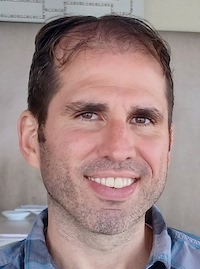
Mark M. WildeQuantum Information Engineer (January 2009-present) Visiting Researcher (October-December 2008) Visiting Researcher (September 2008) Ph.D. August 2008 |
![]() |
Research Interests
Quantum computing, quantum information theory, quantum error correction, and quantum stochastic resonance are my current research interests.
Entanglement-Assisted Quantum Convolutional Coding
The main contribution of my Ph.D. work has been to quantum error correction. This theory is necessary for a quantum computer or quantum communication device to operate reliably.
In particular, Todd Brun and I have developed a detailed theory of entanglement-assisted quantum convolutional codes. A quantum convolutional code is one that operates on a potentially infinite stream of quantum information and uses a periodic encoding circuit to perform the encoding of the quantum stream. An entanglement-assisted quantum error-correcting code is one that exploits entanglement shared between a sender and receiver before quantum communication begins. Todd Brun's and my theory of entanglement-assisted quantum convolutional coding applies to both quantum error correction and distillation of entanglement.
It turns out that the Viterbi algorithm, an efficient algorithm for decoding classical convolutional codes, is useful for decoding an entanglement-assisted quantum convolutional code. Other researchers have shown how to apply the Viterbi algorithm to a quantum convolutional code that does not use entanglement. We have shown how the Viterbi algorithm is useful in entanglement-assisted quantum convolutional coding and received much attention from USC for doing so because of the school's connection to Andrew Viterbi.
Continuous-Variable Quantum Information
It is possible to encode quantum information in an analog or continuous-variable quantum state. The physical implementation for such an analog quantum state is typically as a mode of the electromagnetic field. The advantage right now for analog quantum communication is that it is a little more straightforward for experimentalists to implement quantum protocols with continuous-variable systems. For example, experimentalists have recently implemented a two-mode entangling quantum gate in a continuous-variable system.
Todd Brun and I (and some others) have made a few contributions to the theory of continuous-variable quantum information processing. In particular, we have shown how to perform both entanglement-assisted quantum error correction and operator quantum error correction in a continuous-variable system. This technique might be useful in a future quantum processor if the errors that occur are larger than the uncertainty in the measurement of the errors. We have also shown how to perform coherent communication with continuous-variable quantum processors. Our work on coherent communication shows how to perform coherent teleportation and coherent superdense coding with continuous variables and shows the sense in which these protocols are reversible.
Quantum Stochastic Resonance
Stochastic resonance is a phenomenon that occurs in a wide variety of nonlinear systems. It occurs when a system performs better with noise than without noise.
Bart Kosko and collaborators have published quite a few articles on the occurrence of stochastic resonance in neural processing. The primary content of these articles is a “forbidden-interval” theorem that gives necessary and sufficient conditions for the stochastic resonance noise benefit to occur. Bart Kosko has also published a trade book called Noise that discusses the phenomenon and has resulted in media coverage and an award.
Bart Kosko and I have extended the forbidden-interval theorems to a quantum communication scenario. It exploits the quantum squeezing of light and homodyne detection for the measurement of information. The result is that a quantum stochastic resonance effect occurs in this system and may have applications to continuous-variable quantum key distribution.
Quantum Shannon Theory
Quantum Shannon theory is the study of the ultimate performance limits of quantum communication. It is the quantum generalization of Shannon's theory of classical information (See interesting historical video). Quantum Shannon theory has had many breakthroughs in the past ten years and is beginning to experience a unification.
Researchers continue to make breakthroughs in this field. A recent breakthrough shows that two quantum communication devices that individually cannot transmit quantum information can combine to transmit quantum information reliably. Dave Bacon has written a summary article that describes this effect.
Min-Hsiu Hsieh and I recently devised the classically-enhanced father protocol. This protocol is an optimal protocol for communicating both classical and quantum information when the sender and receiver share entanglement. We mainly use techniques of Devetak and Shor that give an efficient method for "piggybacking" classical information along with quantum information. We have also recently determined the full triple trade-off between classical communication, quantum communication, and entanglement.
Curriculum Vitae
- m a r k . w i l d e (at) usc (dot) e d u
- m w i l d e (at) g m a i l (dot) c o m
Last modified: January 26, 2009.